

Table of Contents
ToggleIntroduction
Artificial intelligence has changed the graphic design industry faster than many people expected. AI-powered tools can now generate images, create layouts, remove backgrounds, suggest color palettes, produce logos, and even turn simple text prompts into polished visual concepts. These developments have naturally raised an important question: Will AI replace graphic designers?
The short answer is more complicated than a simple yes or no. AI is likely to automate some design tasks, but graphic design involves much more than producing an attractive image. Human creativity, communication, brand understanding, strategic thinking, and the ability to interpret a client’s needs remain important.
How AI Is Changing Graphic Design
AI is already being used throughout the design workflow. Designers can use generative tools to create initial concepts, explore different visual styles, resize assets, remove unwanted objects, and produce variations of an existing design.
Tasks that previously required considerable manual effort can sometimes be completed in seconds. For example, a designer working on a social media campaign can use AI to generate several visual concepts before selecting one for further development.
This does not necessarily eliminate the designer’s role. Instead, it can change how designers spend their time.
Which Design Tasks Are Most Likely to Be Automated?
Some repetitive and predictable tasks are particularly suitable for automation. These may include background removal, image resizing, basic photo enhancement, simple layout variations, and generating initial visual concepts.
AI can also produce multiple versions of an advertisement or social media graphic quickly. For businesses that regularly need large amounts of visual content, this can significantly speed up production.
As AI tools become more capable, designers may spend less time on routine production work and more time on creative direction and decision-making.
Creativity Is More Than Generating Images
One of the biggest differences between AI image generation and professional graphic design is the creative process behind the final result.
A graphic designer must understand why a particular visual solution works for a specific audience. A client may have an unclear idea and expect the designer to transform that idea into a practical visual concept.
Design also involves choosing what not to include. Typography, hierarchy, spacing, composition, color, tone, and consistency all influence how people interpret a visual message.
AI can assist with these areas, but human judgment remains important when the project requires context and intentional decision-making.
Understanding the Client’s Brand
Professional designers often work closely with businesses to understand their brand identity. They need to consider the company’s audience, values, competitors, communication style, and long-term visual consistency.
For example, a financial company may require a completely different visual language from a children’s entertainment brand. Simply generating an attractive image is not enough.
A designer must understand the business problem behind the design request and create something appropriate for that purpose.
AI Can Become a Designer’s Assistant
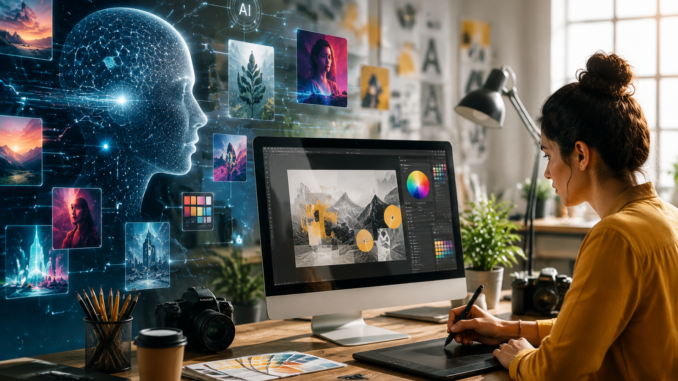
Rather than viewing AI exclusively as a competitor, designers can use it as a productivity tool.
A designer might ask AI to generate mood-board ideas, explore color combinations, produce rough concepts, or create alternative compositions. The designer can then evaluate those results and refine them manually.
This workflow can reduce repetitive work while allowing the designer to focus on higher-value creative decisions.
The Importance of Human Judgment
AI-generated designs can sometimes contain visual inconsistencies, unsuitable typography, incorrect details, or elements that do not match a brand’s requirements.
Human review is therefore important. Designers can identify problems, make precise adjustments, and ensure that the final product communicates the intended message.
In professional environments, accountability also matters. A client needs someone who can understand feedback, make revisions, explain design decisions, and take responsibility for the final deliverable.
Will Entry-Level Design Jobs Change?
Entry-level graphic design work may experience significant changes as AI tools become more widely adopted.
Some tasks traditionally assigned to junior designers could become faster or partially automated. This may encourage aspiring designers to develop skills beyond basic software operation.
Knowledge of branding, typography, UX principles, art direction, marketing, communication, and AI-assisted workflows can help designers remain adaptable.
The ability to use AI effectively may eventually become another standard skill alongside traditional design software.
New Opportunities Created by AI
Technology can also create new opportunities. Businesses that previously could not afford extensive design services may use AI-assisted workflows to produce more visual content.
At the same time, designers can offer services such as creative direction, brand strategy, AI-assisted content production, visual identity development, and quality control.
Designers who understand both traditional principles and emerging AI technology may be able to build more efficient workflows.
What Should Graphic Designers Learn?
Designers do not necessarily need to abandon traditional skills. Instead, they can combine those skills with modern technology.
Important areas to develop include:
- Typography and visual hierarchy
- Branding and identity design
- User experience principles
- Creative direction
- Communication and client management
- Image-editing and design software
- AI-assisted design workflows
- Marketing and audience research
- Critical evaluation of AI-generated content
These skills can help designers contribute beyond simply producing individual graphics.
Conclusion
So, will AI replace graphic designers? AI is likely to replace or automate some design tasks, particularly repetitive production work. However, graphic design involves strategy, communication, creativity, brand understanding, and human judgment that extend beyond generating images.
The industry may therefore move toward a model in which designers work alongside AI rather than simply competing against it. The designers who learn how to combine strong fundamentals with emerging technology may find that AI becomes a powerful creative assistant rather than a replacement for their profession.